

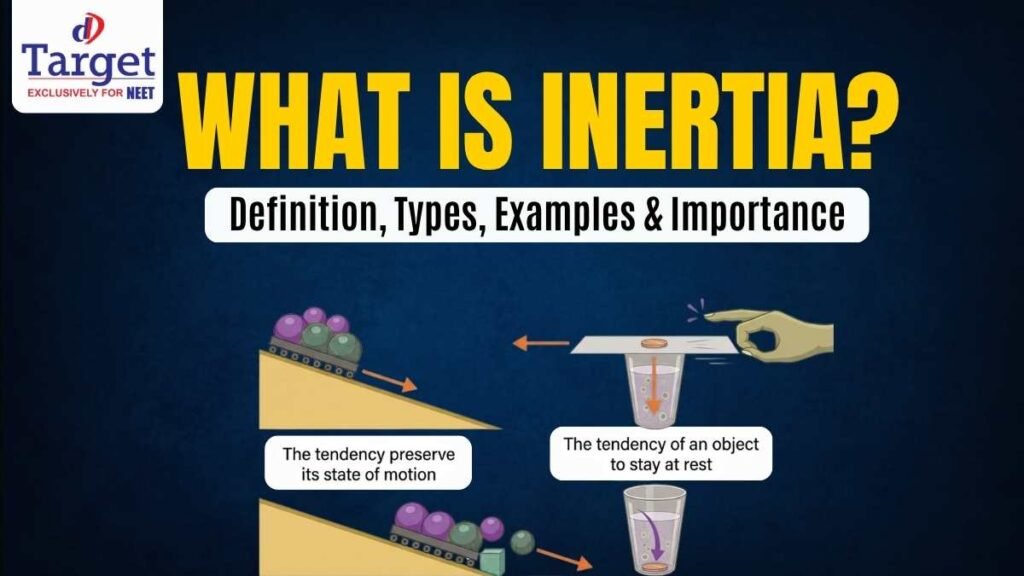
What is Inertia? Definition, Types, Examples & Importance
In Physics, one of the most fundamental and important concepts is inertia. Whether you are preparing for school exams, JEE, or NEET, understanding inertia helps you build a strong foundation in mechanics. At DD Target PMT, we simplify such important concepts to help students grasp them easily and apply them effectively in exams. What is Inertia? Inertia is the property of an object to resist any change in its state of rest or motion. In simple words: This behavior continues unless an external force acts on the object. Real-Life Example of Inertia Imagine you are sitting in a car and the driver suddenly applies brakes. You feel pushed forward. This happens because your body wants to remain in motion even though the car has stopped. This is a perfect example of inertia in everyday life. Newton’s First Law of Motion (Law of Inertia) The concept of inertia is explained by Newton’s First Law of Motion, which states: An object at rest remains at rest, and an object in uniform motion continues in a straight line unless acted upon by an external force. This law is also called the Law of Inertia. Types of Inertia Inertia can be classified into three types: 1. Inertia of Rest The tendency of an object to remain at rest. Example: A book lying on a table does not move unless pushed. 2. Inertia of Motion The tendency of an object to continue moving. Example: A moving bus continues to move unless brakes are applied. 3. Inertia of Direction The tendency of an object to resist changes in its direction. Example: When a car takes a turn, passengers feel pushed sideways. Factors Affecting Inertia Mass and Inertia Inertia depends on the mass of an object. This means heavier objects are harder to move or stop compared to lighter ones. Inertial Frames of Reference An inertial frame of reference is a frame where Newton’s First Law holds true. In such frames: This concept is important for understanding motion in physics. Applications of Inertia in Daily Life Inertia is not just a theory—it has many practical applications. Vehicle Safety Space Science Sports Engineering Why is Inertia Important for Students? For students preparing for JEE and NEET, inertia is a key concept in Physics. Importance At DD Target PMT, we ensure students gain conceptual clarity along with problem-solving skills. Frequently Asked Questions (FAQs) What is inertia in simple words? Inertia is the tendency of an object to resist any change in its motion or rest. Who discovered inertia? The concept of inertia was given by Sir Isaac Newton in his First Law of Motion. How is inertia related to mass? Inertia is directly proportional to mass. Heavier objects have greater inertia. Can inertia be seen in daily life? Yes, inertia is observed in situations like sudden braking, turning vehicles, or moving objects. Final Thoughts Inertia is a fundamental concept that explains how objects behave in motion and at rest. From daily life experiences to advanced scientific applications, inertia plays a crucial role in understanding the physical world. By mastering concepts like inertia, students can build a strong base in Physics and perform better in competitive exams. At DD Target PMT, we help students simplify complex topics and prepare with confidence for exams like JEE and NEET.