

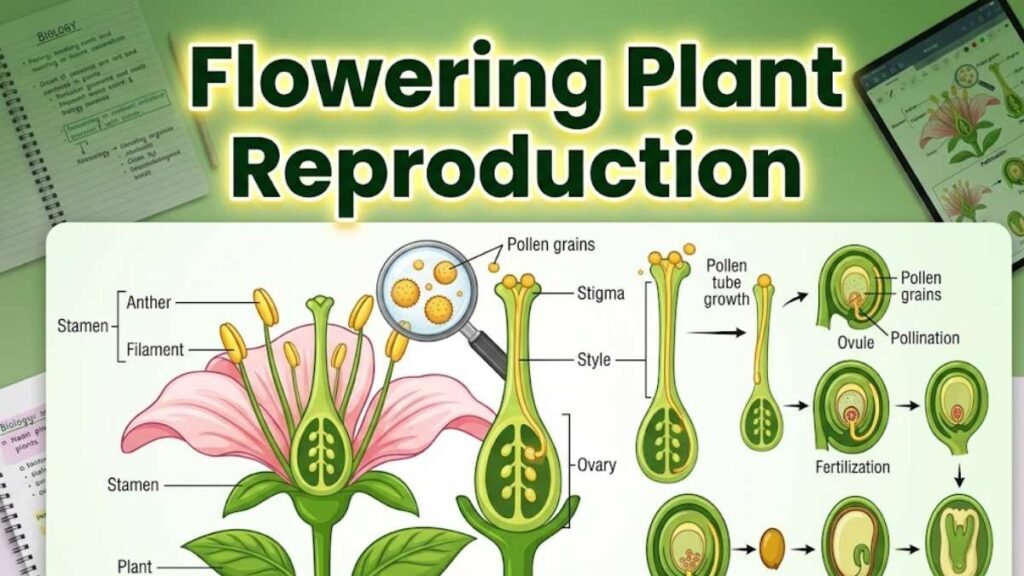
Reproduction in Flowering Plants Summary
The chapter Reproduction in Flowering Plants Summary is one of the most important topics in Class 12 Biology and plays a significant role in NEET preparation. It focuses on how flowering plants reproduce sexually, covering everything from flower structure to seed formation. A clear understanding of this chapter helps students score high marks, as many questions are directly based on NCERT concepts, diagrams, and definitions. In this detailed Reproduction in flowering plants summary class 12, we will simplify the entire chapter in an easy-to-understand and exam-oriented manner. Introduction to Reproduction in Flowering Plants Reproduction is the biological process through which plants produce new individuals. Flowering plants (angiosperms) reproduce sexually through flowers, which are the reproductive organs. This Reproduction in Flowering Plants Summary focuses mainly on sexual reproduction, involving the formation of male and female gametes, pollination, fertilization, and seed development. Structure of a Flower A typical flower consists of four main parts: Sepals Protect the flower in the bud stage. Petals Attract pollinators with color and fragrance. Stamens (Male Reproductive Part) Pistil/Carpel (Female Reproductive Part) Understanding this structure is crucial in the Reproduction in flowering plants summary class 12. Male Gametophyte: Pollen Grain Pollen grains are produced in the anther and contain male gametes. Structure Function 👉 Pollen grains play a key role in the Reproduction in Flowering Plants Summary. Female Gametophyte: Embryo Sac The embryo sac is present inside the ovule and represents the female gametophyte. Structure 👉 This is a frequently asked concept in NEET. Pollination Pollination is the transfer of pollen grains from anther to stigma. Types of Pollination Self-Pollination Transfer within the same flower or plant. Cross-Pollination Transfer between different plants of the same species. Agents of Pollination Pollination is a key step in the Reproduction in flowering plants summary class 12. Fertilization in Flowering Plants Fertilization occurs after pollination. Double Fertilization (Unique Feature) 👉 This process is unique to flowering plants and very important for exams. Post-Fertilization Events After fertilization, several changes occur: Formation of Seed Ovule develops into a seed. Formation of Fruit Ovary develops into fruit. Embryo Development Zygote develops into embryo. These processes complete the Reproduction in Flowering Plants Summary. Types of Seeds Monocot Seeds Dicot Seeds Apomixis and Polyembryony Apomixis Seed formation without fertilization. Polyembryony Formation of multiple embryos in a single seed. 👉 These are advanced concepts in the Reproduction in flowering plants summary class 12. Importance of Reproduction in Flowering Plants Common Mistakes Students Make Avoid these while preparing this Reproduction in Flowering Plants Summary. Quick Revision Tips Why This Chapter is Important for NEET Final Thoughts This Reproduction in Flowering Plants Summary covers all the essential concepts required for NEET and Class 12 exams. By understanding the structure of flowers, pollination, fertilization, and seed formation, you can easily master this chapter. If you revise regularly and focus on NCERT, scoring full marks from this chapter is absolutely possible. The key is consistency, clarity, and smart revision. Master this Reproduction in flowering plants summary class 12, and you will be one step closer to achieving your NEET goals.