
Email

info@ddtarget.com

Every day

10:00am - 6:00pm

Call us

011-41024601-06, 9873558384

Blog

Your blog category

JEE Mains chapter-wise weightage

JEE Mains chapter-wise weightage 2026

The Joint Entrance Examination (JEE Main) is one of the most important exams for students who want to pursue engineering from top institutes like NITs, IIITs, and other prestigious engineering colleges in India. Apart from providing admission opportunities, it also acts as a qualifying exam for JEE Advanced, which opens the path toward IITs. To perform well in the exam, students must understand the JEE Mains chapter-wise weightage so they can prioritize the most important topics. Knowing which chapters appear more frequently helps students revise smartly and focus on areas that can improve their scores quickly. This article provides a complete JEE Main 2026 chapter-wise analysis for Physics, Chemistry, and Mathematics, helping aspirants prepare effectively for the January and April attempts. Why Chapter-Wise Weightage Matters for JEE Main 2026 Understanding the JEE Mains chapter-wise weightage allows students to plan their preparation strategically. Instead of studying every chapter with the same intensity, aspirants can focus more on topics that frequently appear in the exam. Benefits of studying according to JEE Mains chapter-wise weightage include: By analyzing past papers and trends, students can identify the chapters that consistently contribute more questions in the exam. Important Physics Chapters for JEE Main 2026 Physics is a conceptual subject that requires strong fundamentals and problem-solving ability. According to recent exam trends, some topics contribute more questions than others. Below is a list of chapters based on the JEE Mains chapter-wise weightage analysis. High Output, Low Input (Must Do) These chapters require comparatively less preparation but often provide multiple questions in the exam. These topics are frequently highlighted in the JEE Mains chapter-wise weightage because they offer high returns with relatively less effort. High Output Chapters (Rewarding Topics) Some chapters require deeper understanding but have strong scoring potential. Students preparing according to JEE Mains chapter-wise weightage should ensure they thoroughly practice numerical problems from these chapters. Chemistry Chapter-Wise Weightage for JEE Main 2026 Chemistry is divided into three major sections: Studying these subjects according to the JEE Mains chapter-wise weightage helps maximize scoring opportunities. Physical Chemistry – Important Chapters Physical Chemistry involves logical reasoning and numerical calculations. Based on the JEE Mains chapter-wise weightage, the following chapters are highly important. High Output, Low Input High Output Chapters Mole Concept Thermodynamics Chemical Kinetics Electrochemistry Atomic Structure Redox Reactions Solutions Chemical Equilibrium Ionic Equilibrium These chapters appear regularly in exams and should be a priority when preparing based on JEE Mains chapter-wise weightage. Organic Chemistry – Important Preparation Order Organic Chemistry is different from other subjects because it must be studied in a proper sequence. Concepts are interconnected, and understanding one chapter often depends on the previous one. Recommended order of preparation: Completing topics up to Haloalkanes and Haloarenes can help students cover 40–50% of the Organic Chemistry questions in the exam. Some small chapters like: require only 2–3 hours of preparation, yet they appear frequently in exams. These topics are often highlighted in the JEE Mains chapter-wise weightage analysis. Inorganic Chemistry – Important Chapters Inorganic Chemistry is often considered a memory-based subject. However, it can provide quick marks if prepared properly. Below is a priority list based on the JEE Mains chapter-wise weightage trends. Chapter Nature of Chapter Periodic Table Core concept Chemical Bonding Highly important Coordination Compounds Major scoring topic d and f Block Elements Conceptual questions p Block Elements Moderate importance Salt Analysis High input but lower weightage Among these, Chemical Bonding and Coordination Compounds form a major portion of the Inorganic Chemistry questions. Mathematics Chapter-Wise Weightage for JEE Main 2026 Mathematics is a practice-oriented subject, where problem-solving skills are more important than theoretical knowledge. The JEE Mains chapter-wise weightage shows that some topics consistently appear in the exam and should be given special attention. Important Mathematics Chapters Class XI Class XII Remarks Vector Algebra Sequence and Series Highly probable 3D Geometry Binomial Theorem Important Straight Line Determinants High weightage Matrices Permutation and Combination Conceptual Circle Differential Equations Repetitive questions Quadratic Equations Definite Integration Requires practice Complex Numbers Relations and Functions Conceptual Statistics Application of Derivatives Procedural Limits Continuity and Differentiability Important Parabola Probability Moderate Ellipse and Hyperbola Trigonometry Less frequent Basic Mathematics and Logarithm Solution of Triangle Least priority Students should practice these chapters extensively while preparing according to the JEE Mains chapter-wise weightage. Smart Study Tips for JEE Main 2026 Preparation Understanding the JEE Mains chapter-wise weightage is helpful only if students apply it properly during preparation. Below are some effective study strategies. Inorganic Chemistry Memorize key reactions and concepts regularly, preferably in the morning and before bedtime. This technique helps build strong recall ability during exams. Physics Before solving numerical problems, revise formulas and concepts using formula sheets. This improves problem-solving speed. Organic Chemistry Focus on previous year questions (PYQs). Try solving them first before checking the solution to strengthen conceptual clarity. Physical Chemistry Practice numerical problems regularly without relying on calculators. Try to develop a mental approach to solving problems. Mathematics Practice is the most important factor in mathematics. Instead of rushing through many chapters, focus on mastering high-weightage topics. How to Use Chapter-Wise Weightage for Revision The JEE Mains chapter-wise weightage data is based on exam trends from 2020 to 2025. Students should use this information strategically. If your syllabus is already completed If your preparation is incomplete If you have a backlog Instead of trying to complete entire chapters, focus on specific topics that appear frequently in previous year papers. Using the JEE Mains chapter-wise weightage in this way helps students prepare more efficiently even with limited time. Conclusion Success in JEE Main depends not only on hard work but also on smart preparation strategies. Understanding the JEE Mains chapter-wise weightage allows students to focus on the most important topics and maximize their score. By prioritizing high-weightage chapters in Physics, Chemistry, and Mathematics, students can improve their accuracy, strengthen their concepts, and perform better in the exam. Consistent practice, regular revision, and smart planning based on JEE Mains chapter-wise weightage can significantly increase your chances of achieving a …

JEE Mains chapter-wise weightage 2026 Read More »

How to Handle Negative Marking in JEE

How to Handle Negative Marking in JEE

Preparing for the Joint Entrance Examination (JEE) is a challenging journey for students aiming to secure admission into top engineering colleges. While strong conceptual knowledge is essential, understanding the exam pattern and marking scheme is equally important. One of the most critical aspects students must learn is How to Handle Negative Marking in JEE. Negative marking can significantly impact your final score if questions are attempted without proper strategy. Many students lose valuable marks due to guesswork, misreading questions, or poor time management. Understanding How to Handle Negative Marking in JEE can help aspirants improve accuracy and maximize their overall score. At DD Target PMT, mentors often guide students not only in mastering concepts but also in developing smart exam strategies. Learning How to Handle Negative Marking in JEE is a key part of scoring higher marks and achieving a competitive rank. Understanding the Concept of Negative Marking in JEE Before learning How to Handle Negative Marking in JEE, it is important to understand the marking scheme used in the exam. In most JEE papers, the marking pattern follows this structure: Response Type Marks Correct Answer +4 Marks Incorrect Answer –1 Mark Unattempted Question 0 Marks This means that every wrong answer results in the loss of marks. Therefore, blindly attempting every question can reduce your final score. Knowing How to Handle Negative Marking in JEE helps students decide which questions to attempt and which to skip. The key idea behind negative marking is to encourage accuracy rather than random guessing. Why Negative Marking Is Challenging for Students Many students lose marks not because they lack knowledge but because they attempt questions without proper judgment. Understanding How to Handle Negative Marking in JEE helps avoid these mistakes. Some common reasons students lose marks include: Learning How to Handle Negative Marking in JEE ensures students focus on solving questions with confidence and clarity. Read Questions Carefully Before Answering One of the simplest yet most effective techniques for How to Handle Negative Marking in JEE is reading each question carefully. Many students lose marks because they overlook important words such as: These keywords completely change the meaning of a question. If a student reads too quickly, they may select the wrong answer despite knowing the concept. Taking a few extra seconds to read the question properly is an important strategy for How to Handle Negative Marking in JEE. Attempt Questions with High Confidence First Another important rule for How to Handle Negative Marking in JEE is attempting questions in which you are confident first. During the first round of solving the paper: This approach builds momentum and ensures that you secure marks in the questions you know well. Following this strategy is a proven way to improve performance while learning How to Handle Negative Marking in JEE. Use the Elimination Method The process of elimination is one of the smartest strategies for How to Handle Negative Marking in JEE. If you are unsure about a question: Even if you are left with two options, your probability of selecting the correct answer increases significantly. Students who master this technique often perform better because they understand How to Handle Negative Marking in JEE strategically rather than relying on guesswork. Manage Your Time Efficiently Time management plays a crucial role in How to Handle Negative Marking in JEE. Many students make mistakes simply because they rush during the final minutes of the exam. A smart time strategy may look like this: Stage of Exam Strategy First Round Solve easy and confident questions Second Round Attempt moderate difficulty questions Final Round Revisit doubtful questions Ideally, students should spend around 2–3 minutes per question, depending on the complexity. Practicing timed mock tests can help develop this skill. Proper time management reduces careless mistakes and is essential for mastering How to Handle Negative Marking in JEE. Practice Mock Tests Regularly Mock tests are one of the best ways to learn How to Handle Negative Marking in JEE effectively. Regular practice helps students: After each mock test, students should carefully analyze their mistakes. Maintaining an error log helps track repeated errors and prevents them in the actual exam. Students who consistently practice mock tests develop a clear understanding of How to Handle Negative Marking in JEE and perform better on exam day. Stay Calm During the Exam Exam pressure often causes students to make rushed decisions. Maintaining a calm mindset is essential for How to Handle Negative Marking in JEE. Simple techniques to stay focused include: A calm mind helps improve logical thinking and reduces careless mistakes. This mental discipline is an important factor in learning How to Handle Negative Marking in JEE. Avoid Changing Answers Without a Strong Reason Another common mistake students make is changing answers without proper reasoning. Often, the first instinct is correct. When practicing How to Handle Negative Marking in JEE, students should avoid changing answers unless: Unnecessary answer changes can lead to avoidable negative marks. Final Tips to Reduce Negative Marking in JEE Students aiming for top ranks should develop smart strategies for How to Handle Negative Marking in JEE. The following tips can help reduce unnecessary mark loss: By following these strategies, students can significantly reduce negative marking and improve their overall score. Conclusion Understanding How to Handle Negative Marking in JEE is just as important as mastering the syllabus. Many students lose valuable marks not because they lack knowledge but because they attempt questions without a proper strategy. With the right preparation approach, smart question selection, and strong time management skills, students can successfully manage negative marking. Consistent practice, mock tests, and careful exam strategies will help aspirants convert their knowledge into a higher score. At DD Target PMT, students are trained not only in subject concepts but also in exam strategies that improve accuracy and performance. By learning How to Handle Negative Marking in JEE, aspirants can maximize their marks and move one step closer to securing admission in top engineering colleges.

NEET Biology Syllabus 2026

NEET Biology Syllabus 2026 – Complete Chapter List

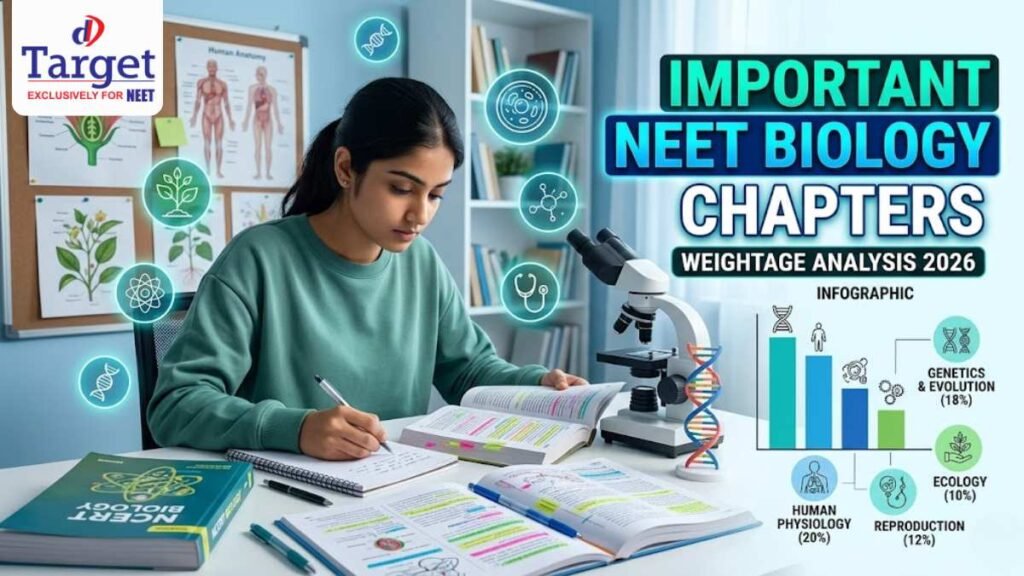
The NEET Biology Syllabus 2026 is the most important part of the NEET preparation process because Biology carries the highest weightage in the NEET exam. Out of the total 720 marks, Biology alone contributes 360 marks, making it the most scoring subject for medical aspirants. The NEET Biology Syllabus 2026 is based mainly on the NCERT Class 11 and Class 12 Biology textbooks. The syllabus includes important topics from Botany and Zoology, covering areas such as cell biology, human physiology, genetics, ecology, plant physiology, and biotechnology. Students preparing for the exam should thoroughly understand the NEET Biology Syllabus 2026 because most NEET questions are directly based on NCERT concepts, diagrams, and definitions. A clear understanding of the syllabus helps aspirants focus on important chapters and build a strong preparation strategy. NEET Biology Syllabus 2026 Overview The NEET Biology Syllabus 2026 includes topics from both Class 11 and Class 12 Biology. These topics are divided into several units that cover the fundamental concepts of life sciences. Biology Section Overview Feature Details Subject Biology (Botany + Zoology) Total Questions 90 Total Marks 360 Source of Syllabus NCERT Class 11 & Class 12 Question Type Multiple Choice Questions Understanding the structure of the NEET Biology Syllabus 2026 helps students organize their study plan effectively. Class 11 Topics in NEET Biology Syllabus 2026 Class 11 Biology builds the foundation for understanding the basic structure and functioning of living organisms. Class 11 Biology Topics Unit Chapter Name Important Concepts Diversity in Living World Biological Classification Kingdom classification, taxonomy Plant Kingdom Plant diversity Algae, bryophytes, gymnosperms Animal Kingdom Animal classification Chordates and non-chordates Structural Organisation in Plants Morphology of plants Root, stem, leaf Structural Organisation in Animals Animal tissues Tissue types and functions Cell Structure and Function Cell biology Cell organelles, biomolecules Cell Cycle and Cell Division Mitosis and meiosis Chromosomes and cell reproduction Plant Physiology Photosynthesis and respiration Plant growth regulators Human Physiology Body systems Digestive, circulatory, nervous systems These chapters are fundamental parts of the NEET Biology Syllabus 2026 and form the base for advanced biological concepts. Class 12 Topics in NEET Biology Syllabus 2026 Class 12 Biology focuses on advanced topics such as genetics, reproduction, biotechnology, and ecology. Class 12 Biology Topics Unit Chapter Name Important Concepts Reproduction Human reproduction Reproductive health Genetics and Evolution Mendelian genetics DNA replication and evolution Molecular Basis of Inheritance Gene expression Transcription and translation Biotechnology Genetic engineering Recombinant DNA technology Biotechnology Applications Medical biotechnology GM crops and vaccines Biology and Human Welfare Human health Diseases and immunity Ecology and Environment Ecosystems Biodiversity conservation Environmental Issues Environmental protection Sustainable development These chapters complete the NEET Biology Syllabus 2026 and are very important for scoring high marks in the exam. Total Chapters in NEET Biology Syllabus 2026 The NEET Biology Syllabus 2026 includes a large number of chapters from both Class 11 and Class 12. Chapter Distribution Class Number of Chapters Class 11 15 Class 12 23 Total 38 Chapters Students should plan their preparation carefully to cover the entire NEET Biology Syllabus 2026 before the exam. Important Chapters in NEET Biology Although every topic in the NEET Biology Syllabus 2026 is important, some chapters often carry higher weightage in the NEET exam. High-Weightage Biology Topics Chapter Importance Human Physiology Frequently asked questions Genetics and Evolution Conceptual questions Cell Biology Basic biological concepts Plant Physiology Photosynthesis and respiration Ecology Environmental and biodiversity questions Biotechnology Modern biology applications Students who thoroughly understand these chapters can perform better while covering the NEET Biology Syllabus 2026. Biology Weightage in NEET Exam Biology plays the most important role in the NEET exam. Biology Section Weightage Subject Questions Marks Biology 90 360 A strong command of the NEET Biology Syllabus 2026 can significantly improve a student’s overall NEET score. Best Strategy to Cover NEET Biology Syllabus 2026 Completing the NEET Biology Syllabus 2026 requires consistent study and regular revision. Preparation Tips 1. Follow NCERT Books ThoroughlyMost NEET Biology questions come directly from NCERT. 2. Revise Diagrams and DefinitionsMany exam questions are based on diagrams and key definitions. 3. Practice MCQs RegularlySolving multiple-choice questions helps improve accuracy. 4. Focus on Important ChaptersHigh-weightage chapters should be revised more frequently. 5. Revise FrequentlyRegular revision ensures better retention of concepts from the NEET Biology Syllabus 2026. Common Mistakes Students Make in Biology Preparation While preparing for the NEET Biology Syllabus 2026, students often make several mistakes that can affect their performance. Mistakes to Avoid Avoiding these mistakes will help students master the NEET Biology Syllabus 2026 more effectively. Conclusion The NEET Biology Syllabus 2026 forms the backbone of NEET preparation because it carries the highest marks in the exam. The syllabus includes important topics from NCERT Class 11 and Class 12 Biology such as human physiology, genetics, ecology, biotechnology, and plant biology. Students who thoroughly study the NEET Biology Syllabus 2026, revise regularly, and practice MCQs consistently will have a strong advantage in the NEET exam. With proper planning, conceptual understanding, and consistent practice, aspirants can achieve a high score and move closer to their dream of entering the medical field.

NEET Physics Syllabus 2026

NEET Physics Syllabus 2026

The NEET Physics Syllabus 2026 is an essential part of the preparation strategy for students aspiring to crack the NEET exam. Physics is often considered one of the most challenging subjects in the NEET examination because it requires both conceptual clarity and strong numerical problem-solving skills. The NEET Physics Syllabus 2026 is based on the NCERT Class 11 and Class 12 Physics curriculum. It includes important topics from mechanics, thermodynamics, optics, electromagnetism, and modern physics. Students preparing for NEET should study the NEET Physics Syllabus 2026 carefully to understand which chapters are included in the exam and how to prioritize their preparation. Mastering the NEET Physics Syllabus 2026 requires consistent practice, conceptual understanding, and regular revision of formulas and numerical methods. NEET Physics Syllabus 2026 Overview The NEET Physics Syllabus 2026 includes topics from both Class 11 and Class 12 NCERT textbooks. Physics questions in NEET usually test students’ ability to apply formulas and concepts to solve numerical problems. Overview of Physics Section in NEET Feature Details Subject Physics Total Questions 45 Total Marks 180 Question Type Objective (MCQs) Syllabus Source NCERT Class 11 & 12 Understanding the structure of the NEET Physics Syllabus 2026 helps students focus on important chapters and manage their study time effectively. Class 11 Topics in NEET Physics Syllabus 2026 Class 11 topics mainly focus on mechanics and basic physics concepts, which form the foundation for advanced chapters. Class 11 Physics Topics Unit Chapter Name Important Concepts Units and Measurements Measurement and errors SI units, dimensional analysis Kinematics Motion in one and two dimensions Velocity, acceleration, projectile motion Laws of Motion Newton’s laws Friction, circular motion Work, Energy and Power Energy conservation Work-energy theorem Rotational Motion Rotational dynamics Torque, moment of inertia Gravitation Universal law of gravitation Satellite motion Properties of Matter Elasticity, fluid mechanics Surface tension, viscosity Thermodynamics Heat and temperature Laws of thermodynamics Kinetic Theory Molecular theory of gases Gas laws Oscillations and Waves Simple harmonic motion Wave motion These chapters are an important part of the NEET Physics Syllabus 2026 and frequently appear in NEET exam questions. Class 12 Topics in NEET Physics Syllabus 2026 Class 12 Physics topics are more advanced and include electromagnetism, optics, and modern physics. Class 12 Physics Topics Unit Chapter Name Important Concepts Electrostatics Electric charges and fields Coulomb’s law, electric potential Current Electricity Electrical circuits Ohm’s law, Kirchhoff’s laws Magnetic Effects of Current Magnetism Biot–Savart law, Ampere’s law Electromagnetic Induction Induction and AC Faraday’s laws Electromagnetic Waves Wave properties EM spectrum Optics Ray optics and wave optics Reflection, refraction, interference Dual Nature of Matter Photoelectric effect Wave-particle duality Atoms and Nuclei Atomic structure Nuclear reactions Electronic Devices Semiconductor physics Diodes, logic gates These chapters complete the NEET Physics Syllabus 2026 and are essential for scoring well in the Physics section. Total Chapters in NEET Physics Syllabus 2026 Understanding the number of chapters helps students plan their preparation better. Chapter Distribution Class Number of Chapters Class 11 10 Class 12 9 Total 19 Chapters The NEET Physics Syllabus 2026 covers these 19 chapters from the NCERT curriculum. Important Chapters in NEET Physics While every topic in the NEET Physics Syllabus 2026 is important, some chapters frequently carry higher weightage in the exam. High-Weightage Physics Topics Chapter Importance Laws of Motion Fundamental mechanics concepts Rotational Motion Frequently asked numerical problems Current Electricity Circuit-based questions Electrostatics Conceptual and numerical questions Optics Ray and wave optics questions Modern Physics Short conceptual questions Students should focus on these chapters while covering the NEET Physics Syllabus 2026. Physics Weightage in NEET Exam Physics plays an important role in the NEET exam. Physics Section Weightage Subject Questions Marks Physics 45 180 A strong understanding of the NEET Physics Syllabus 2026 can significantly improve a student’s overall NEET score. Best Strategy to Cover NEET Physics Syllabus 2026 Completing the NEET Physics Syllabus 2026 requires a structured preparation strategy. Effective Preparation Tips 1. Focus on Concept ClarityUnderstanding fundamental concepts is essential before solving numerical problems. 2. Practice Numerical Questions DailyPhysics requires regular problem-solving practice. 3. Memorize Important FormulasMany questions in the NEET Physics Syllabus 2026 require quick formula application. 4. Solve Previous Year PapersThis helps understand the exam pattern and difficulty level. 5. Revise RegularlyFrequent revision strengthens conceptual understanding and improves accuracy. Common Mistakes Students Make in Physics Preparation While preparing for the NEET Physics Syllabus 2026, students often make several mistakes. Mistakes to Avoid Avoiding these mistakes will help students master the NEET Physics Syllabus 2026 more effectively. Conclusion The NEET Physics Syllabus 2026 includes important chapters from the NCERT Class 11 and Class 12 Physics curriculum. It covers topics such as mechanics, thermodynamics, electromagnetism, optics, and modern physics. Students preparing for the NEET exam should study the NEET Physics Syllabus 2026 carefully and focus on building strong conceptual understanding along with regular numerical practice. Physics may seem challenging at first, but with consistent effort and the right preparation strategy, students can perform well in this subject. By mastering the NEET Physics Syllabus 2026, aspirants can significantly improve their chances of scoring higher marks and securing admission into top medical colleges.

NEET Chemistry Syllabus 2026

NEET Chemistry Syllabus 2026

The NEET Chemistry Syllabus 2026 is one of the most important parts of the NEET preparation journey for medical aspirants. Chemistry carries 180 marks out of the total 720 marks in the NEET exam, making it a crucial subject for achieving a high score. The NEET Chemistry Syllabus 2026 is based mainly on the NCERT Class 11 and Class 12 Chemistry curriculum. It includes topics from Physical Chemistry, Organic Chemistry, and Inorganic Chemistry. A clear understanding of the NEET Chemistry Syllabus 2026 helps students focus on important chapters and avoid unnecessary topics during preparation. Students preparing for the medical entrance exam must study the NEET Chemistry Syllabus 2026 carefully because many questions are directly based on NCERT concepts, reactions, and theoretical principles. NEET Chemistry Syllabus 2026 Overview The NEET Chemistry Syllabus 2026 includes topics from both Class 11 and Class 12 Chemistry textbooks. The subject is divided into three main branches. Chemistry Section Distribution Section Description Physical Chemistry Numerical-based concepts and formulas Organic Chemistry Reaction mechanisms and carbon compounds Inorganic Chemistry Periodic table, chemical properties, and reactions Understanding the structure of the NEET Chemistry Syllabus 2026 helps students organize their preparation effectively. NEET Chemistry Syllabus 2026 – Physical Chemistry Physical Chemistry focuses on numerical problem solving, chemical calculations, and conceptual understanding. Many questions from the NEET Chemistry Syllabus 2026 are formula-based and require practice. Physical Chemistry Topics Unit Important Topics Some Basic Concepts of Chemistry Mole concept, stoichiometry, empirical formula Atomic Structure Bohr model, quantum numbers, electronic configuration Chemical Bonding Ionic bond, covalent bond, hybridization, molecular geometry Thermodynamics Enthalpy, entropy, Gibbs free energy Solutions Concentration terms, Raoult’s law, colligative properties Equilibrium Chemical equilibrium, ionic equilibrium Redox Reactions Oxidation number, balancing reactions Electrochemistry Electrochemical cells, Nernst equation Chemical Kinetics Rate of reaction, activation energy A strong command of these topics is essential to master the NEET Chemistry Syllabus 2026. NEET Chemistry Syllabus 2026 – Inorganic Chemistry Inorganic Chemistry focuses mainly on conceptual understanding and memorization of chemical properties, reactions, and periodic trends. Inorganic Chemistry Topics Unit Important Topics Classification of Elements Modern periodic table, periodic trends p-Block Elements Properties and reactions of Group 13–18 elements d- and f-Block Elements Transition elements and inner transition elements Coordination Compounds Ligands, nomenclature, bonding theories Environmental Chemistry Environmental pollution and its control Students preparing according to the NEET Chemistry Syllabus 2026 should revise these chapters frequently because they contain many theory-based questions. NEET Chemistry Syllabus 2026 – Organic Chemistry Organic Chemistry is considered one of the most scoring parts of the NEET Chemistry Syllabus 2026. Understanding reaction mechanisms and functional groups is essential. Organic Chemistry Topics Unit Important Topics Basic Principles of Organic Chemistry Hybridization, isomerism, electronic effects Hydrocarbons Alkanes, alkenes, alkynes, aromatic compounds Haloalkanes and Haloarenes Substitution reactions Alcohols, Phenols and Ethers Reactions and preparation methods Aldehydes and Ketones Nucleophilic addition reactions Carboxylic Acids Properties and chemical reactions Amines Classification, reactions, diazonium salts Biomolecules Carbohydrates, proteins, nucleic acids These chapters are essential parts of the NEET Chemistry Syllabus 2026 and frequently appear in NEET question papers. Chapter Distribution in NEET Chemistry Syllabus 2026 The NEET Chemistry Syllabus 2026 includes chapters from both Class 11 and Class 12. Chapter Distribution Table Class Number of Chapters Class 11 14 Class 12 16 Total 30 Chapters Understanding this distribution helps students plan their preparation according to the NEET Chemistry Syllabus 2026. Weightage of Chemistry in NEET Exam Chemistry contributes significantly to the overall NEET score. Chemistry Exam Weightage Subject Questions Marks Chemistry 45 180 Students who thoroughly cover the NEET Chemistry Syllabus 2026 can score well because many questions are direct and concept-based. Best Strategy to Cover NEET Chemistry Syllabus 2026 Completing the NEET Chemistry Syllabus 2026 requires a balanced preparation strategy. Effective Study Strategy 1. Study NCERT ThoroughlyMost NEET Chemistry questions are directly based on NCERT concepts. 2. Practice Numerical ProblemsPhysical Chemistry requires regular numerical practice. 3. Revise Reactions FrequentlyOrganic Chemistry reactions must be revised regularly. 4. Focus on Periodic TrendsInorganic Chemistry questions often come from periodic properties. 5. Solve Previous Year QuestionsPracticing past NEET papers helps understand the exam pattern. Following these methods will help students master the NEET Chemistry Syllabus 2026 effectively. Common Mistakes Students Make in Chemistry Preparation While studying the NEET Chemistry Syllabus 2026, many students make avoidable mistakes. Common Mistakes Avoiding these mistakes helps students perform better in the NEET exam. Conclusion The NEET Chemistry Syllabus 2026 plays a crucial role in the success of medical aspirants preparing for the NEET examination. The syllabus includes important topics from Physical, Organic, and Inorganic Chemistry based on NCERT Class 11 and Class 12 textbooks. Students who thoroughly understand the NEET Chemistry Syllabus 2026, practice numerical problems regularly, revise chemical reactions, and solve previous year questions will have a strong advantage in the exam. With consistent practice and a clear preparation strategy, mastering the NEET Chemistry Syllabus 2026 becomes much easier and can significantly improve a student’s chances of securing a high rank in the NEET exam.

NEET Maths Syllabus 2026

NEET Maths Syllabus 2026

The NEET Maths Syllabus 2026 is a topic that many students search online while preparing for medical entrance exams. However, it is important to understand that Mathematics is not included in the official NEET exam syllabus. The National Eligibility cum Entrance Test (NEET-UG) evaluates students only in Physics, Chemistry, and Biology. Even though the NEET Maths Syllabus 2026 is often discussed among aspirants, the exam itself does not contain any Mathematics questions. Instead, mathematical concepts are indirectly used in Physics calculations and numerical problem solving. Understanding this fact helps students avoid confusion and focus on the correct subjects required for NEET preparation. In this guide, we will clarify the NEET Maths Syllabus 2026, explain how mathematics concepts appear in Physics problems, and discuss the topics students should focus on. Is Mathematics Included in NEET 2026? Many students preparing for the medical entrance exam wonder whether they need to study Mathematics. The answer is simple: NEET does not include a separate Mathematics subject. The official NEET Maths Syllabus 2026 does not exist because the exam consists of only three subjects: Subject Number of Questions Marks Physics 45 180 Chemistry 45 180 Biology 90 360 Total 180 720 Therefore, aspirants preparing for NEET should mainly focus on Physics, Chemistry, and Biology, rather than searching for a detailed NEET Maths Syllabus 2026. Why Students Search for NEET Maths Syllabus 2026 Even though Mathematics is not officially included, students often search for the NEET Maths Syllabus 2026 for several reasons: Because of this, some basic mathematical understanding can help in mastering the Physics section of NEET. Mathematical Concepts Used in NEET Physics Although there is no official NEET Maths Syllabus 2026, certain mathematical concepts are frequently used while solving physics questions. Important Mathematics Concepts for NEET Physics Topic Usage in Physics Algebra Used in equations and numerical problem solving Trigonometry Important for vectors, projectile motion, and waves Logarithms Used in calculations involving exponential relations Graph Interpretation Used in motion graphs, thermodynamics, and electricity Basic Calculus Helpful in understanding rate of change and motion concepts Vectors Used in mechanics, forces, and electromagnetism Students who understand these concepts will find it easier to solve Physics problems within the NEET exam. Mathematical Skills Required for NEET Preparation Although the NEET Maths Syllabus 2026 is not officially part of the exam, aspirants still need certain mathematical abilities to solve numerical questions efficiently. Important Skills 1. Basic Calculation Speed Quick calculations help save time during the exam. 2. Algebraic Manipulation Physics equations often require rearranging formulas. 3. Graph Reading Ability Graphs are used in mechanics, electricity, and thermodynamics. 4. Formula Application Students must apply formulas correctly in numerical problems. These skills indirectly support preparation even though the NEET Maths Syllabus 2026 itself is not included in the exam. Recommended Study Approach for NEET Students Instead of focusing on a separate NEET Maths Syllabus 2026, aspirants should prioritize the subjects that actually appear in the exam. Ideal Study Strategy Step Study Approach Step 1 Focus on NCERT Physics, Chemistry, and Biology Step 2 Practice numerical questions regularly Step 3 Strengthen basic mathematics used in Physics Step 4 Solve previous year NEET questions Step 5 Take mock tests to improve speed and accuracy Following this strategy ensures that students spend their time effectively rather than worrying about the NEET Maths Syllabus 2026. Difference Between NEET and Other Exams with Mathematics Some competitive exams require Mathematics, but NEET is different. Comparison Table Exam Subjects Included NEET Physics, Chemistry, Biology JEE Physics, Chemistry, Mathematics CUET Science Depends on selected subjects Engineering Entrance Exams Physics, Chemistry, Mathematics This is why the NEET Maths Syllabus 2026 is not officially defined. Common Misconceptions About NEET Maths Syllabus 2026 Many aspirants have confusion about mathematics in NEET preparation. Myth vs Reality Myth Reality NEET includes Mathematics questions NEET has no mathematics section Students must study full Class 11 & 12 Maths Only basic math skills are required Mathematics is required for Biology students Biology students can appear without Maths Understanding the truth about the NEET Maths Syllabus 2026 helps students stay focused on the correct preparation strategy. Conclusion The NEET Maths Syllabus 2026 is a commonly searched topic among students preparing for medical entrance exams. However, NEET does not include Mathematics as a separate subject. The exam evaluates students only in Physics, Chemistry, and Biology. While there is no official NEET Maths Syllabus 2026, basic mathematical concepts such as algebra, trigonometry, and graph interpretation are useful for solving Physics problems. Aspirants should focus on mastering the official NEET subjects, practicing numerical questions regularly, and strengthening their conceptual understanding. With the right preparation strategy and consistent practice, students can perform well in the NEET exam and move closer to their dream of becoming medical professionals.

NEET Syllabus 2026

NEET Syllabus 2026 – Complete Subject-Wise Syllabus

The NEET Syllabus 2026 is the official academic framework that medical aspirants must follow while preparing for the National Eligibility cum Entrance Test (NEET-UG). The syllabus outlines all the chapters and concepts that students need to study from Physics, Chemistry, and Biology based on the NCERT Class 11 and Class 12 curriculum. The NEET Syllabus 2026 has been finalized by the Undergraduate Medical Education Board (UGMEB) under the National Medical Commission (NMC) and released by the National Testing Agency (NTA). This syllabus serves as a complete roadmap for aspirants aiming to secure admission into MBBS, BDS, and other medical courses in India. Understanding the NEET Syllabus 2026 is essential because it helps students: In this detailed guide, we will cover the complete NEET Syllabus 2026, subject-wise chapters, exam pattern, chapter distribution, and preparation strategies. NEET Syllabus 2026 Overview The NEET Syllabus 2026 mainly includes topics from NCERT Class 11 and Class 12 textbooks for Physics, Chemistry, and Biology. NEET 2026 Syllabus Overview Table Feature Details Exam Name National Eligibility cum Entrance Test (NEET-UG) Conducting Body National Testing Agency (NTA) Syllabus Authority National Medical Commission (NMC) Subjects Included Physics, Chemistry, Biology Total Marks 720 Total Questions 180 Duration 3 Hours 20 Minutes NCERT Coverage Class 11 & Class 12 A clear understanding of the NEET Syllabus 2026 allows aspirants to prepare effectively and stay aligned with the official exam requirements. Subject-Wise NEET Syllabus 2026 The NEET Syllabus 2026 is divided into three major subjects: Each subject includes chapters from both Class 11 and Class 12 NCERT textbooks. Biology Syllabus for NEET 2026 Biology carries the highest weightage in the NEET Syllabus 2026, contributing 360 marks out of 720. Most questions in NEET are directly based on NCERT Biology chapters, diagrams, and definitions. NEET Biology Syllabus 2026 – Units & Topics Unit Chapter Area Important Topics Unit 1 Diversity in Living World Five kingdom classification, taxonomy, plant kingdom, animal kingdom Unit 2 Structural Organisation Morphology of flowering plants, plant anatomy, animal tissues Unit 3 Cell Structure and Function Cell organelles, biomolecules, enzymes, mitosis and meiosis Unit 4 Plant Physiology Photosynthesis, respiration in plants, plant growth regulators Unit 5 Human Physiology Digestive system, breathing, circulation, excretion, nervous system Unit 6 Reproduction Human reproduction, reproductive health, flowering plant reproduction Unit 7 Genetics and Evolution Mendelian genetics, DNA replication, transcription, translation Unit 8 Biology and Human Welfare Human diseases, immunity, microbes in human welfare Unit 9 Biotechnology Recombinant DNA technology, gene therapy, genetically modified organisms Unit 10 Ecology and Environment Ecosystem, biodiversity conservation, environmental issues Students studying the NEET Syllabus 2026 should revise Biology regularly because many questions are memory-based and concept-based. Physics Syllabus for NEET 2026 Physics evaluates conceptual understanding, problem-solving skills, and mathematical application. The NEET Syllabus 2026 for Physics includes topics from classical mechanics, electromagnetism, optics, and modern physics. NEET Physics Syllabus 2026 – Units & Topics Unit No Unit Name Topics Included Unit 1 Units and Measurements SI units, dimensional analysis, errors in measurement Unit 2 Kinematics Motion in straight line, projectile motion Unit 3 Laws of Motion Newton’s laws, friction Unit 4 Work, Energy and Power Work energy theorem, conservation of energy Unit 5 Rotational Motion Torque, angular momentum Unit 6 Gravitation Kepler’s laws, satellite motion Unit 7 Properties of Matter Elasticity, viscosity, fluid mechanics Unit 8 Thermodynamics First and second law of thermodynamics Unit 9 Kinetic Theory of Gases Gas laws, kinetic theory Unit 10 Oscillations and Waves SHM, sound waves Unit 11 Electrostatics Electric charges, electric field Unit 12 Current Electricity Ohm’s law, electrical circuits Unit 13 Magnetism Magnetic effects of current Unit 14 Electromagnetic Induction Faraday’s laws, AC circuits Unit 15 Electromagnetic Waves EM wave spectrum Unit 16 Optics Ray optics, wave optics Unit 17 Dual Nature of Matter Photoelectric effect Unit 18 Atoms and Nuclei Atomic models, nuclear physics Unit 19 Electronic Devices Semiconductors and logic gates Unit 20 Experimental Skills Measurement instruments and experiments Regular numerical practice is essential for mastering the NEET Syllabus 2026 Physics section. Chemistry Syllabus for NEET 2026 Chemistry in the NEET Syllabus 2026 includes three branches: NEET Chemistry Syllabus 2026 – Important Topics Section Unit Topics Physical Chemistry Basic Concepts Mole concept, stoichiometry Atomic Structure Quantum numbers, electronic configuration Thermodynamics Laws of thermodynamics, enthalpy Equilibrium Chemical equilibrium, ionic equilibrium Solutions Concentration terms, colligative properties Electrochemistry Electrochemical cells Chemical Kinetics Rate of reaction Inorganic Chemistry Periodic Table Periodicity, periodic trends p-Block Elements Properties and reactions d & f Block Elements Transition metals Coordination Compounds Ligands, nomenclature Organic Chemistry Basic Principles Hybridization, reaction mechanisms Hydrocarbons Alkanes, alkenes, alkynes Oxygen Compounds Alcohols, aldehydes, ketones Nitrogen Compounds Amines Biomolecules Carbohydrates, proteins, nucleic acids Students preparing according to the NEET Syllabus 2026 should practice both conceptual questions and reaction-based problems. Total Chapters in NEET Syllabus 2026 The NEET Syllabus 2026 includes chapters from both Class 11 and Class 12. Chapter Distribution Table Subject Class 11 Chapters Class 12 Chapters Total Physics 10 9 19 Chemistry 14 16 30 Biology 15 23 38 Total 39 48 87 Understanding this distribution helps students manage the NEET Syllabus 2026 effectively. NEET 2026 Exam Pattern Knowing the exam pattern is just as important as understanding the NEET Syllabus 2026. NEET Exam Pattern Table Subject Number of Questions Marks Physics 45 180 Chemistry 45 180 Biology 90 360 Total 180 720 Marking Scheme Action Marks Correct Answer +4 Wrong Answer −1 Unattempted 0 Duration of exam: 3 hours 20 minutes Students who thoroughly study the NEET Syllabus 2026 and practice according to this exam pattern can significantly improve their score. Tips to Cover NEET Syllabus 2026 Effectively Completing the NEET Syllabus 2026 requires consistent effort and a strategic approach. Effective Preparation Tips Follow NCERT FirstNCERT textbooks should be the primary study material for Biology and Chemistry. Create a Study ScheduleDivide the NEET Syllabus 2026 into weekly or monthly study targets. Practice MCQs DailyRegular practice helps improve speed and accuracy. Revise FrequentlyRevisiting old chapters ensures long-term retention. Solve Previous Year PapersThis helps understand the exam pattern and question trends. Conclusion …

NEET Syllabus 2026 – Complete Subject-Wise Syllabus Read More »

class 12 commerce syllabus cbse 2026

Class 12 Commerce Syllabus CBSE 2026

The class 12 Commerce Syllabus CBSE 2026 is designed to develop strong business, financial, and economic understanding among students. Commerce is one of the most popular streams in senior secondary education because it opens doors to multiple career opportunities in finance, management, entrepreneurship, accounting, and economics. The class 12 Commerce Syllabus CBSE 2026 mainly includes subjects such as Accountancy, Business Studies, Economics, Entrepreneurship, and Legal Studies. Each subject focuses on building analytical thinking, decision-making skills, and practical knowledge required in the modern business world. Students preparing according to the class 12 Commerce Syllabus CBSE 2026 also gain a strong foundation for competitive exams and professional courses such as CA, CS, CMA, B.Com, BBA, and CUET. In this detailed guide, we will explore the subject-wise syllabus structure, important topics, and marking scheme. Overview of Class 12 Commerce Syllabus CBSE 2026 The class 12 Commerce Syllabus CBSE 2026 focuses on developing both theoretical knowledge and practical understanding of commerce-related subjects. The main objectives of this syllabus include: The class 12 Commerce Syllabus CBSE 2026 also includes project work and practical assessments to ensure students gain real-world knowledge along with theoretical learning. Accountancy Syllabus – Class 12 Commerce Accountancy is one of the most important subjects in the class 12 Commerce Syllabus CBSE 2026. It focuses on financial records, accounting procedures, and financial statement analysis. Accountancy Syllabus Structure Parts & Units Topics Covered Marks Part A: Accounting for Partnership Firms and Companies 60 Unit 1: Accounting for Partnership Firms Partnership deed, fixed vs fluctuating capital, profit & loss appropriation account, goodwill valuation, admission, retirement, death of partner, reconstitution, dissolution of firms 36 Unit 2: Accounting for Companies Share capital, issue of shares, forfeiture and reissue, disclosure of share capital, debentures and redemption 24 Part B: Financial Statement Analysis 20 Unit 3: Analysis of Financial Statements Meaning, objectives, tools of analysis, comparative statements, ratio analysis 12 Unit 4: Cash Flow Statement Preparation of cash flow statement using indirect method 8 OR Computerised Accounting Structure of accounting systems, spreadsheet usage, accounting software applications 20 Part C: Project Work Project File + Viva 20 Students studying the class 12 Commerce Syllabus CBSE 2026 must focus on concept clarity and practical problem-solving for accountancy. Business Studies Syllabus – Class 12 Commerce Business Studies is another key subject in the class 12 Commerce Syllabus CBSE 2026 that helps students understand management principles and business operations. Business Studies Syllabus Structure Part Units Covered Marks Part A: Principles and Functions of Management Nature and Significance of Management, Principles of Management, Business Environment, Planning, Organising, Staffing, Directing, Controlling 50 Part B: Business Finance and Marketing Financial Management, Financial Markets, Marketing Management, Consumer Protection 30 Part C: Project Work One practical project based on business concepts 20 Total 100 The class 12 Commerce Syllabus CBSE 2026 ensures students understand how organizations operate and how managers make decisions. Economics Syllabus – Class 12 Commerce Economics helps students understand national and global economic systems. The class 12 Commerce Syllabus CBSE 2026 divides Economics into two main sections. Economics Syllabus Structure Part / Units Topics Covered Marks Part A: Introductory Macroeconomics 40 Unit 1 National Income and Related Aggregates 10 Unit 2 Money and Banking 6 Unit 3 Determination of Income and Employment 12 Unit 4 Government Budget and Economy 6 Unit 5 Balance of Payments 6 Part B: Indian Economic Development 40 Unit 6 Development Experience and Economic Reforms 12 Unit 7 Current Challenges Facing the Indian Economy 20 Unit 8 Development Experience of India Compared with Neighbours 8 Part C: Project Work Research-based economic project 20 Students following the class 12 Commerce Syllabus CBSE 2026 learn to analyze economic issues and understand policy decisions. Legal Studies Syllabus – Class 12 Commerce Legal Studies introduces students to the basics of law and the Indian legal system. It is an important optional subject in the class 12 Commerce Syllabus CBSE 2026. Legal Studies Syllabus Overview Units Unit Name Marks Unit 1 Judiciary 8 Unit 2 Alternative Dispute Resolution 8 Unit 3 Business Laws 20 Unit 4 General Laws 10 Unit 5 Human Rights 10 Unit 6 International Law 8 Unit 7 Legal Profession in India 8 Unit 8 Legal Services 8 Theory Total 80 Project Work / Internal Assessment 20 The class 12 Commerce Syllabus CBSE 2026 helps students understand legal frameworks used in business and society. Entrepreneurship Syllabus – Class 12 Commerce Entrepreneurship focuses on business planning, innovation, and startup development. This subject is becoming increasingly popular in the class 12 Commerce Syllabus CBSE 2026. Entrepreneurship Syllabus Structure Unit No. Unit Name Marks Unit 1 Entrepreneurial Opportunity 30 Unit 2 Entrepreneurial Planning Unit 3 Enterprise Marketing 20 Unit 4 Enterprise Growth Strategies Unit 5 Business Arithmetic 20 Unit 6 Resource Mobilization Theory Total 70 Project Work Business Plan + Market Survey 30 Grand Total 100 Through the class 12 Commerce Syllabus CBSE 2026, students gain practical knowledge about starting and managing a business. Importance of Class 12 Commerce Syllabus for Career Growth The class 12 Commerce Syllabus CBSE 2026 plays a major role in shaping a student’s career. It prepares students for multiple professional fields such as: Students who thoroughly understand the class 12 Commerce Syllabus CBSE 2026 can build a strong academic base for higher education. Tips to Study Class 12 Commerce Syllabus Effectively To perform well in exams, students should follow a strategic study plan while covering the class 12 Commerce Syllabus CBSE 2026. Helpful preparation tips include: Following these strategies can help students master the class 12 Commerce Syllabus CBSE 2026 and score better in board exams. Conclusion The class 12 Commerce Syllabus CBSE 2026 provides students with a comprehensive understanding of business, finance, economics, and entrepreneurship. It combines theoretical knowledge with practical applications to prepare students for professional careers and higher education. By carefully studying each subject and completing project work effectively, students can develop strong analytical and problem-solving skills. With proper planning, dedication, and regular revision, mastering the class 12 Commerce Syllabus CBSE 2026 becomes much easier. This …

Class 12 Commerce Syllabus CBSE 2026 Read More »

Best Books for NEET 2026

Best Books for NEET 2026 – Complete Subject-Wise

Preparing for NEET requires dedication, discipline, and most importantly, the right study resources. Every year, thousands of students start their preparation but struggle to decide which books they should follow. The truth is that selecting the Best Books for NEET 2026 can make a huge difference in how effectively you cover the syllabus and perform in the exam. Many aspirants believe that studying from many books will increase their chances of success. However, toppers often follow a completely different approach. They rely on a limited number of high-quality resources and revise them multiple times. This strategy helps them develop conceptual clarity and exam-level accuracy. In this article, we will discuss the Best Books for NEET 2026 with subject-wise recommendations for Biology, Chemistry, and Physics. These suggestions are designed to help students build strong fundamentals, practice effectively, and maximize their score potential. Why Choosing the Right Books Matters for NEET 2026 The NEET exam tests conceptual understanding, problem-solving ability, and accuracy. Without the correct resources, students may waste valuable preparation time studying irrelevant or overly complicated material. Choosing the Best Books for NEET 2026 ensures that your preparation stays aligned with the official syllabus and exam pattern. The right books help you: Students who carefully select the Best Books for NEET 2026 often find it easier to stay organized and focused during their preparation journey. NCERT – The Foundation of NEET Preparation Before discussing additional reference books, it is important to understand one key rule for NEET preparation. NCERT textbooks are the foundation of NEET preparation. Most NEET questions are either directly or indirectly based on NCERT concepts, diagrams, tables, and definitions. Therefore, every student must start their preparation with NCERT before moving to advanced resources. The Best Books for NEET 2026 always include NCERT textbooks for: Once the NCERT concepts are clear, students can use reference books for deeper understanding and additional practice. Best Books for NEET Biology Preparation Biology plays the most important role in the NEET exam. It contributes 360 marks out of 720, which means mastering this subject can significantly boost your rank. Selecting the Best Books for NEET 2026 for Biology can help students strengthen their memory, improve conceptual clarity, and become comfortable with NCERT-based questions. Recommended Biology Books Book Name Purpose NCERT Biology (Class 11 & 12) The most important book for NEET preparation. Every line, diagram, and concept should be thoroughly studied. Trueman’s Biology (Vol 1 & 2) Helps expand concepts beyond NCERT while staying within the NEET syllabus. MTG NCERT at Your Fingertips – Biology Excellent for quick revision and NCERT-based MCQ practice. Objective Biology Helps students practice exam-level MCQs and improve accuracy. Students searching for the Best Books for NEET 2026 should remember that NCERT Biology must be read multiple times. Reference books should only be used after mastering NCERT. Best Chemistry Books for NEET Chemistry is a balanced subject in NEET. It includes theoretical concepts, numerical problems, reactions, and memory-based topics. Choosing the Best Books for NEET 2026 for Chemistry allows students to manage Physical, Organic, and Inorganic Chemistry efficiently. Recommended Chemistry Books Book Name Purpose NCERT Chemistry (Class 11 & 12) The primary source for NEET chemistry questions. O.P. Tandon (Physical Chemistry) Helps strengthen numerical concepts and problem-solving skills. Physical Chemistry by P. Bahadur Useful for extensive numerical practice. Organic Chemistry by Morrison & Boyd Builds strong understanding of reaction mechanisms. Concise Inorganic Chemistry by J.D. Lee Helps simplify complex inorganic topics. Objective Chemistry Provides topic-wise MCQ practice for exam preparation. Students preparing with the Best Books for NEET 2026 should keep Organic and Inorganic Chemistry strictly NCERT-focused. Best Physics Books for NEET Physics is often considered the most challenging section of the NEET exam. Unlike Biology, it requires strong conceptual understanding and problem-solving ability. The Best Books for NEET 2026 for Physics should help students build strong fundamentals before moving to advanced questions. Recommended Physics Books Book Name Purpose NCERT Physics (Class 11 & 12) Essential for theory clarity and formula understanding. Concepts of Physics – H.C. Verma One of the most trusted books for building strong fundamentals. Objective Physics – D.C. Pandey Provides NEET-level MCQ practice. Fundamentals of Physics – Halliday, Resnick & Walker Useful for deeper conceptual understanding. MTG NCERT at Your Fingertips – Physics Ideal for quick revision and exam-oriented practice. Students choosing the Best Books for NEET 2026 should first focus on understanding concepts rather than solving extremely advanced problems. How to Use NEET Preparation Books Effectively Simply owning the Best Books for NEET 2026 does not guarantee success. The real difference lies in how you use them. A proven preparation strategy includes: Students who follow this structured approach while using the Best Books for NEET 2026 often perform better in the exam. Are NCERT Books Enough for NEET 2026? This is one of the most common questions among aspirants. NCERT books are essential but may not be sufficient alone for achieving a top rank. They form the foundation, but additional practice is required. Think of it this way: When used together, the Best Books for NEET 2026 create a complete preparation system. Conclusion NEET preparation is not about collecting many books but about studying the right ones consistently. Students who succeed are those who revise the same material multiple times and practice regularly. Selecting the Best Books for NEET 2026 helps create a focused study plan, improves conceptual clarity, and boosts confidence before the exam. With the right books, disciplined study, and regular revision, every aspirant can move closer to their dream of securing a medical seat. Frequently Asked Questions (FAQs) 1. What are the most recommended books for NEET preparation? Students should start with NCERT textbooks for all subjects and then refer to selected reference books for additional practice. 2. Which book is best for beginners preparing for NEET? NCERT Class 11 and Class 12 textbooks are considered the best starting point for NEET preparation. 3. Which books are best for NEET Biology preparation? NCERT Biology should be studied first, followed by …

Best Books for NEET 2026 – Complete Subject-Wise Read More »

CO Full Form

CO Full Form: Meaning, Role, Responsibilities

Many students preparing for competitive exams such as UPSC, State PCS, SSC, and other government examinations often come across the term CO and wonder about its meaning. Understanding administrative designations is important for general awareness as well as for exam preparation. In simple terms, CO Full Form is Circle Officer. A Circle Officer plays a significant role in maintaining law and order, implementing government policies, and supervising administrative functions within a defined geographical area known as a circle. In this detailed guide by DD Target PMT, we will explain the CO Full Form, roles and responsibilities, eligibility, duties, and career path in a clear and easy-to-understand way. CO Full Form in Government Administration The CO Full Form is Circle Officer. A Circle Officer is a government officer responsible for overseeing administrative, law enforcement, and revenue-related activities within a specific region called a circle. A circle usually consists of several villages, towns, or subdivisions within a district. The position of Circle Officer is commonly found in the police administration and revenue administration systems in India. The officer acts as a bridge between district-level administration and local governance. Understanding the CO Full Form is particularly important for students preparing for competitive examinations where questions related to administrative posts are frequently asked. What is a Circle Officer? A Circle Officer is responsible for ensuring that governance at the local level runs smoothly. The officer supervises law enforcement activities, manages administrative work, and ensures that government schemes reach the people effectively. The CO Full Form refers to a position that requires leadership, coordination, and decision-making skills. The officer often works closely with police stations, revenue departments, and local authorities to maintain order and development in the region. The jurisdiction of a Circle Officer usually includes several police stations or villages within a district. Key Responsibilities of a Circle Officer The role associated with the CO Full Form is quite broad and involves several administrative and operational duties. A Circle Officer performs multiple responsibilities that help maintain effective governance. 1. Maintaining Law and Order One of the primary duties related to the CO Full Form is maintaining peace and law and order within the assigned circle. The officer supervises police personnel and ensures that laws are implemented properly. They also monitor criminal activities, review investigations, and take necessary action to maintain public safety. 2. Administrative Management Circle Officers handle many administrative responsibilities within their jurisdiction. They ensure that government policies and programs are properly implemented at the local level. Through the authority associated with the CO Full Form, officers coordinate with various departments to provide public services efficiently. 3. Revenue Administration Another important duty related to the CO Full Form is supervising revenue-related tasks. These include: Revenue administration plays a major role in rural governance, making this responsibility extremely important. 4. Implementation of Government Schemes Circle Officers ensure that welfare schemes and development programs reach the public. Through the authority associated with the CO Full Form, officers monitor the implementation of projects related to: They also ensure transparency and accountability in these programs. 5. Development and Public Welfare A major part of the role associated with the CO Full Form is identifying developmental needs in the circle. Officers work with local government bodies and community organizations to improve living standards. Development activities may include: 6. Crisis and Disaster Management During emergencies such as floods, earthquakes, or other disasters, Circle Officers play a critical role in coordinating rescue and relief efforts. The authority linked to the CO Full Form allows them to coordinate with multiple departments to ensure the safety of citizens and manage resources efficiently. Jurisdiction of a Circle Officer The area under the authority of a Circle Officer is called a circle. This geographical unit may include several villages, towns, or police stations within a district. The CO Full Form represents an officer who supervises activities within this area and ensures proper administration and law enforcement. Eligibility to Become a Circle Officer Students who aspire to become a Circle Officer must meet certain educational and competitive exam requirements. Generally, candidates must: Most candidates become Circle Officers through Civil Services or State Public Service Commission examinations. Understanding the CO Full Form is useful for students aiming for careers in administration, police services, or public governance. Skills Required to Become a Circle Officer To perform the duties associated with the CO Full Form, an officer must develop several important skills: These skills help Circle Officers effectively manage their responsibilities. Why the Role of a Circle Officer is Important The position associated with the CO Full Form is extremely important in the administrative system. Circle Officers ensure that government policies reach people at the grassroots level. They also play a key role in: Without effective officers performing the duties linked to the CO Full Form, local governance would become difficult to manage. Career Opportunities for Circle Officers A career connected with the CO Full Form provides many opportunities for growth in government administration. With experience and performance, officers may receive promotions to higher administrative or police positions. Many officers go on to hold important roles in district administration and public governance. This makes the role both prestigious and impactful for those who wish to serve the nation. Conclusion The CO Full Form stands for Circle Officer, an important administrative position responsible for maintaining law and order, implementing government policies, and overseeing development activities within a defined area. Circle Officers play a crucial role in connecting district administration with local communities. From revenue management to crisis response, their responsibilities cover many aspects of governance. For students preparing for competitive exams or aspiring to work in government services, understanding the CO Full Form and its responsibilities is essential. With dedication, preparation, and strong administrative skills, aspiring candidates can build a successful and respected career in this field. FAQs What is the CO Full Form? The CO Full Form is Circle Officer. A Circle Officer is a government official responsible for managing administrative and law enforcement activities within a …

CO Full Form: Meaning, Role, Responsibilities Read More »

Fill this form for admission


    This will close in 120 seconds